
The job of a modern keyboardist is not to play notes, but rather to support the story arc of the song with sound
BLUF: Listen -> Less is More -> Eradicate Obstacles (technical / mechanical) so you can be present and in the moment
A Vocabulary of Sound
- Cymatics: Youtube
- Wendy Carlos – Switched on Bach: link
- M83 (Inspiration for Hillsong): iTunes
- Firechild (features individual analog synths): iTunes
- TRON Legacy (Daft Punk: Analog Synthesis + Orchestral Strings): iTunes
- Workshop Playlist: iTunes
The Band
1 Corinthians 12: 12-27 IKV 😉 | Unity and Diversity in the Band
The worship band is not made up of one instrument but of many.
Now if the kick drum should say, “Because I am not a snare, I do not belong to the drum kit,” it would not for that reason stop being part of the kit. And if the keyboards should say, “Because I am not an electric guitar, I do not belong to the band.” it would not for that reason stop being part of the band.
The keys cannot say to the guitars, “I don’t need you!” And the vocals cannot say to the rhythm section, “I don’t need you!” On the contrary, those parts of the body that seem to be weaker (i.e. sound engineer) are indispensable, and the parts that we think are less honorable (e.g. bassist) we treat with special honor. And the parts that are unpresentable are treated with a drum shield, while our vocalists need no special treatment.
If the whole band were a rhythm section where would the sense of melody be? If the whole band were harmony, where would the sense of rhythm be? But in fact God has placed the parts in the band, every one of them, just as he wanted them to be. If they were all one part, where would the band be? As it is, there are many instruments, but one band.
But God has put the band together, giving greater honor to the parts that lacked it, so that there should be no division in the band, but that its parts should have equal concern for each other.
If one part suffers, every part suffers with it; if one part is honored, every part rejoices with it.
Now you are the band, and each one of you is a part of it.
Cheap But Good Advice for Playing In A Group ~ Chick Corea
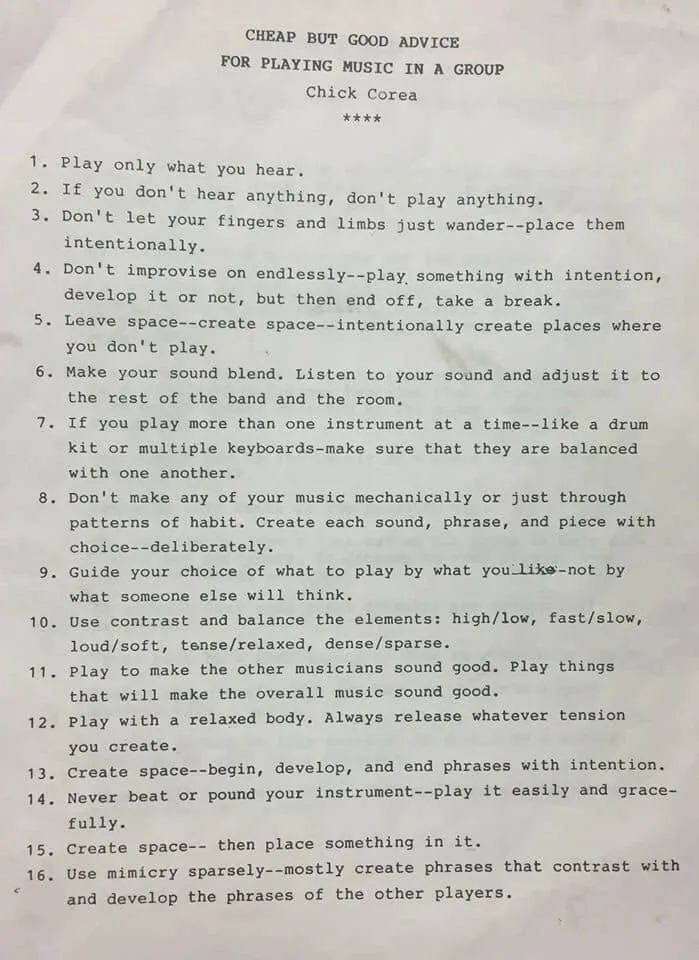
- Play only what you hear.
- If you don’t hear anything, don’t play anything.
- Don’t let your fingers and limbs wander — place them intentionally.
- Don’t improvise on endlessly — play something with intention, develop it or not, but then end off, take a break.
- Leave space — create space — intentionally create places where you don’t play.
- Make your sound blend. Listen to your sound and adjust it to the rest of the band and the room.
- If you play more than one instrument at a time — like a drum kit or multiple keyboards — make sure that they are balanced with one another.
- Don’t make any of your music mechanically or just through patterns of habit. Create each sound, phrase, and piece with choice — deliberately.
- Guide your choice of what to play by what you like-not by what someone else will think.
- Use contrast and balance the elements: high/low, fast/slow, loud/soft, tense/relaxed, dense/sparse.
- Play to make the other musicians sound good. Play things that will make the overall music sound good.
- Play with a relaxed body. Always release whatever tension you create.
- Create space — begin, develop, and end phrases with intention.
- Never beat or pound your instrument — play it easily and gracefully.
- Create space — then place something in it.
- Use mimicry sparsely — mostly create phrases that contrast with and develop the phrases of the other players.
Theory Smackdown
- Time signatures like 4/4 and 6/8 especially
- Key signatures, know the circle of fifths
- Know major scales in all keys (three octaves, both hands)
- Learn the most popular chords first in each key: I, IV, V, VIm
- Learn all the Inversions to these chords (three octaves, both hands)
- Add in the variations: Sus4, Sus2, 7, 9, 11, diminished, augmented
- Voicing – you are now ready to figure out how you hear the part
Sound Design
Fouriers Theorem provides a nice foundation for understanding what sound is
Preparation
- Listen to the song a hundred times
- Figure out the essentials that you can reasonable cover
- Deconflict the parts you will cover with the MD / band / engineer
- Do your sound design before rehearsal in terms of one scene for each section
- Rehearse to the tracks without sounds e.g. on an old upright piano – be loose
- Rehearse your parts with the appropriate sounds, fine tune your scenes at rehearsal
- Get to bed early, and get a good nights sleep, then be the first to arrive
- When the time comes, simply be present in each and every moment